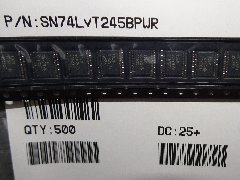
SN74LVT245BPWR is a 3.3V ABT eight-channel bus transceiver introduced by Texas Instruments. It adopts a 20-pin TSSOP surface mount packaging. This device is specifically designed for low-voltage, high-speed bidirectional bus communication, enabling bidirectional level conversion and driving between data buses.
This transceiver contains 8 bidirectional channels. The direction of data transmission is controlled by the DIR pin: when DIR is at a high level, data is transmitted from port A to port B; when DIR is at a low level, data is transmitted from port B to port A. The output enable terminal (OE) can control the output to enter a high-impedance state, achieving bus isolation.
Operating voltage range: 2.7V to 3.6V. Supports LVTTL level input compatibility. The output driving capability is strong, with a pull current of 32mA and a drive current of 64mA. It is fabricated using BiCMOS technology, with a typical static current of 190µA.
Features :
• Logic type: Transceiver, non-inverting, 8-bit bidirectional
• Direction Control: The DIR pin controls the direction of data transmission.
• Output type: Three-state (3-State), with output enable (OE) control
• Operating voltage: 2.7V ~ 3.6V, compatible with 3.3V system
• Output driving capability: Pull-in current 32mA, Drive current 64mA
• Propagation delay: Typical value 2.3 ns @ 3.3V, 50 pF
• Static Current (Iq): 190 µA
• Functional features: Hot-swapping support, power-off isolation, level conversion function
• Wide operating temperature range: Industrial grade -40°C ~ +85°C
• Compact package: TSSOP-20, size 6.50mm × 4.40mm, pin pitch 0.65mm
• MSL Level: Level-1 (Unrestricted)
• Environmental compliance: Meets RoHS standards, lead-free (Pb-Free), with Ni/Pd/Au surface treatment for pins
Application:
• Computer bus interface: Data bus driver between the CPU and external devices
• Embedded System: Bidirectional Communication Between MCU/FPGA and Peripheral Devices
• I/O bus expansion: Level matching of PCI, VME and other bus interfaces
• Communication equipment: Data transmission and reception of RS-485 differential signal system
• Data acquisition system: Multiplexing and isolation of sensor data streams